By Stephen Bent
Part 2:
It was not a stumble; I didn’t snag my boot on a root or slip in the wet. It was a drop. It was that precipice. And I ran straight off the edge of it. Straight off of the world I’d been hurrying through and into a deep, high-sided bowl scooped into the forest floor. A hole in the ground, slick with leaves and shadows. I had landed hard on the side of the hole and slid down into its lowest point.
With the breath punched from my lungs and my momentum stopped, I collapsed into a heap near the bottom. Something metallic skittered away from me into the mushy, pulpy leaves as I came to a stop. The compass.
I scrambled toward it instinctively, fingers reaching to grasp the gift Mum had given me for Cubs. And then I froze. Bewildered by what I saw. The compass lay in two imperfect pieces.
Cleaved. One side was almost two-thirds of the object. The edges are as clean as polished glass.
The rectangle the dial was mounted on now looked like a wedge. The glass was not cracked but cut perfectly with glinting edges. The needle too was severed. The larger part lay on top of leaves; the smaller piece continued to tumble for a second longer.
Something brushed my cheek. As light as a whisper. That’s when I saw it.
A vertical line, rising from the earth exactly where the compass had fallen. Thin as spider silk, yet unmistakably solid. Impossibly tall. It climbed past twisted branches into the colourless sky, unwavering.
I held my breath. A leaf drifted down lazily. As it touched the line, it parted silently. Two halves spiralled down, settling on either side. I studied the two halves of the leaf as they spiralled down to the ground, now on two separate paths of wind and gravity. One half clipped the line a second time. It became two more pieces again. One larger, one tiny. Finally, they rested on the ground.
One right by the point the line stands proud of the earth. My eyes widened as I drank in the details of all the leaves around it. They were all cleaved in two by a perfect straight edge.
I surveyed the ground, and there are twigs in amongst the leaves. Does it cleave the trees the same way it did the leaves, my compass? When the wind blows a twig into its path?
Slowly, the slowest I’ve ever moved, I eased backwards. The line didn’t move. It didn’t hum. It simply existed. Standing impossibly tall. From the leaves to the sky.
Only when my back met roots sticking out of the side of the slope did I stop backing up. I sat there until my breathing calmed, until my panic-beating, rage-driven heart softened into something smaller. And I looked at the line reaching up into the canopy of the forest. And I felt its presence. I felt like it might feel mine too.
It went so high I could not see the top of it. It was so thin I wasn’t sure at what point I lost sight of it. Was it where it met the branches of trees? Staring up, I was convinced I could see it reach past the top. A circle of branches seemed to part around it, allowing it to sail up into the grey above.Did it reach the sky where aeroplanes flew? Would it cut a 747 in two the way it did my compass? Did it go into space? Did it reach down into the rocks below? How long had this thing stood here? Was this bowl in the ground caused by it? I had so many questions. Until I hit upon
one that scared me more than the others.
Is it alone? Was this the only strand of immovable, sharp cutting edge in this forest? Or were the woods full of these things? Slowly. Very, very carefully, I tried to leave the bowl. Pulling myself up on the roots, I began to plot a route out of the dip. As I climbed out, my caution focused on two things. Don’t fall backwards, don’t slip, and don’t suddenly find yourself face to face with the razor’s edge. And keep your eyes peeled for others. Watch how the leaves fall. Look to the sky, look at the leaves. Don’t accidentally rush into another one.
On the walk home, I moved so slowly I must have looked like a statue at times. I scanned every trunk, every post. Afraid of lines too straight.
When I got to the clearing, Dad was gone. I didn’t go out the rest of the day. He came home in the afternoon. Hauling firewood and a hessian bag of groceries into the kitchen. I put myself to bed without dinner in the early evening. But I didn’t sleep.
—
I didn’t go back straight away. My curiosity grew quietly, like roots in cold soil; the terror of escaping the line became curiosity about what I’d seen and then doubt that I’d seen it at all. Dad and I found a routine. Ways to keep the peace between us. Fragile though it was. We stopped talking about Mum. We stopped talking about feelings. We discussed many things. Fire, woodwork, car maintenance, and school bus routine. But never thoughts, hopes or fears. And that way, we didn’t openly hate each other.
I tried to be as invisible as possible at school. Stay in the crowd. Slip off when nobody is looking. Find ways to not be seen or picked for anything. That part came easily most days. But I couldn’t shake the feeling I’d seen something totally unique. I’d seen and interacted with something utterly eternal. Weeks went past, and whenever I closed my eyes, I saw the crack in the world. the hairline fracture that had the sharpest edge imaginable.
Eventually, I went to the school library. Miss Redding pointed me toward reference books and told me not to bend the spines. I found nothing useful. Optical illusions. Fences. Power lines.
Light refraction.
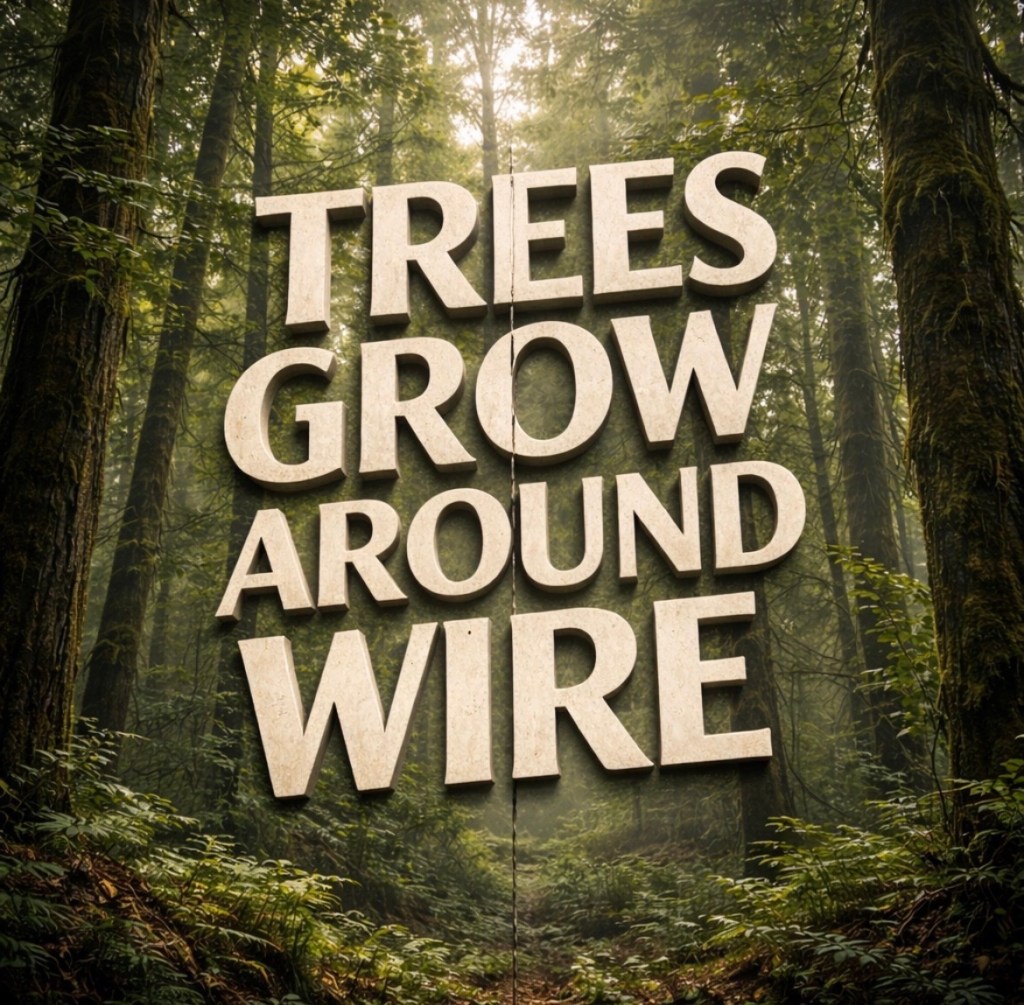
But one afternoon, buried in a battered paperback on rural hazards, I found a single line. ‘Given time, trees will always grow around wire.’ Plain. Unadorned. It hit clean. I borrowed the bookand read that sentence nightly. Sometimes I traced it with my finger. I didn’t fully understand.
But it felt like the shape of something true. I still didn’t tell Dad. Silence had become furniture.
—
By the time I’d reached thirteen, I’d decided that would be a watershed. A real teenager. A young adult. The age of many. I walked deeper into the woods after school every night. testing my boundaries. My caution around there being ‘other lines’ remained. But I developed safe paths. In, out, around. One summer evening, my feet found their way back to the dell before my mind caught up. I knew for months and months that I’d come back. I just didn’t know it would be this night. Until I was there. The evening sun had taken on a golden glow.
The thread was still there. The sunset caught the line high above the trees. A shaft of gold.
Beautiful but almost so thin you would not see it if you were not looking for it. But I’d been looking for it subconsciously every day in a way. Wondering if it was thinking about me the way
I had been thinking about it. But it hadn’t. It had just been here. Not moving. Not wanting or waning. Just here. Solid and so, so thin.
As I gazed up and down the line, and without thinking, I started to climb down into the hole.
Gently and carefully planning my route so I didn’t slip. I never took my eyes off of it. The fear remained, but my curiosity stood taller. Once on the flat earth of the bottom, most leaves from the autumn had rotted away, so I stood on grass and moss. I sat at the bottom for hours, watching consequences fall in silence. When I finally climbed out, my head felt clearer.
That scared me more than the thread did.
I returned monthly. Respectfully. I never touched it. I watched raindrops bead along its length in summer storms, splitting into twin streams when they met the line. I tested grass blades, feathers, and twigs. Each parted perfectly. I pondered the line from the book, “Given time, trees grow around wire.” I had seen it now with my own eyes.
The fence around the clearing that circled the cottage, our home. Part taught, part wire fence post. Where it passed the first row of trees that marked the edge of the forest, there was a fine example. A fence that Dad had told me he had helped put up with Grandad. Back when he was my age. It was now absorbed as part of the environment around which the tree lived. There was no hole in the bark. The wire went in one side and came out the other.
The fence posts themselves had weathered and weakened with age. They still stood up. But they were not the formidable structure they once had been. But for the trees’ intervention, they would have remained in place. Doing their job. The trees’ absorption of the presence of the fence was indifferent. The trees just kept growing despite the man-made barrier. Until it was part of the fence, and the fence was part of the tree.So I sat looking at this thing. This implausible, eternal, indifferent, deathly thing. The thread wasn’t violent. It was indifferent. And that spoke to me in fearful ways I couldn’t name.
—
At fifteen, an axis shifted again. Dad made up with his sister, my aunt. For years, they hadn’t spoken. Not since we moved to the cottage. Was it because we moved to the cottage? I didn’t know. But now they were reconciled, and that meant my cousin on my dad’s side reappeared in my life. Two and a half years without him had passed. I didn’t realize what a pleasure that had been.
Always confident, a lot taller, with a grin sharpened by universal approval. I couldn’t bear him.
All adults adored him, instinctively. He was a bully. Behind the scenes, a violent thug with a clean smile and a way of throwing adults off his scent. I could smell the rot in him. And he could smell the fear in me.
We ate dinner at my aunt’s house. Voices overlapped. Laughter inflated the room. The years apart seemed to melt away for Dad and for my aunt. For her husband and for my cousin, too. They talked of memories. Of what was missed in between, but never of the rift. Never of reconciliation or regret. Only forward. They drank and ate and made merry. And when the meal was done, they encouraged my cousin and me to head outside together.
To get some exercise. To go and have some fun. My cousin seemed to genuinely like that idea.
He said he wanted to show me his bike. His goalposts. His den is at the bottom of their huge garden. I nodded in agreement and dreaded the idea. So once plates had cleared, and adults had uncorked another bottle, we were dismissed.
At first, things were polite enough. We sat on the patio furniture while my cousin spun the wheels on his upturned BMX and talked about brakes, tyre treads and pads that fitted on the frame of its hot-rod red frame. I was polite. I told him my bike was once Grandad’s. It weighed a ton. He laughed and called me a word I’d never heard before. I knew it was a slur.
As our time in the garden wore on, his tone shifted. “Why’d she really leave?” he whispered after putting his bike away as he tried to keep a run of volleys going with a football. “I don’t know,” I muttered, and he kicked the ball at me. It hit my hands and bounced back to him. He laughed. “She used to buy me good birthday presents. “I liked her,” he said, rolling the ball on his foot again for another three keepie uppies before it rolled off onto the lawn. “Me too. She was good at presents.” He cuffed the back of my head. “Bet she couldn’t stand the idea of living in those woods. You reek of them, you know.” I said nothing. Some cruelties are rehearsed. He’d been thinking about sticking me since I entered the house. I could tell. And now he’d done it; I just hoped he was done. “We should get into it one day,” he said. “You and me. Mano andMono.” I didn’t correct him.
A month later, my aunt and her whole rotten household visited our cottage. Dad and Uncle shared manly exchanges outside the cottage. Roasting each other lightly with teases and roughhousing. My aunt had me show her around the cottage. She seemed to disapprove of the state of every single thing she saw. My cousin seemed even bigger and more verbose outside of his home. In mine, it felt like a violation. My quiet, monk-like peace and carefully trodden routines are violated by loud voices, questions and judgment. Again, a big meal where we all sat across the table. My aunt cooked it before she came. She heated it up once it had got here. I have to admit it was nice to have new potatoes, carrots and gravy. To have home-cooked (but not this home) food filling the house with a smell that made me remember Mum.
Dad had the wine covered. This is what was considered his way of hosting. Provide the wine.
And the sloes. The stuff he’d got bottled under the stairs. Grimy-looking second-hand bottles filled with homemade forest-fruit-based booze. When opened, it reeked, and it always made the glasses dirty. I knew they’d get to that wretched stuff soon enough. So I tried to make my excuses. “I’ve got homework to do. I have to go to my room later.” I was planning to give myself some quiet time. Hoping my cousin would find me boring and want to stay with his parents and
Dad instead of me. I wanted an escape boat in time.
“Don’t worry about that,” boomed Dad. “Why don’t you show your cousin around? Show him what you find so fascinating in those woods all the time.” I wanted to protest. I wanted to just say no. But I always do as I am told. So when the last of the ice cream and crumble had been scraped from the bowls, my cousin’s hand on my shoulder was all the signal it took. And that was the end of the only good meal I’d ever tasted in Forester’s Cottage.
“Come on, Shrimp,” he said, and the adults all laughed. “I’ll race you through the woods.” I suddenly wanted to throw up everything I’d just eaten. “Go on, son. Get out of here. Give us adults some space, yeah?” I nodded. I swallowed hard. And I went to pull on my boots. I just knew this was going to go badly. I just knew.
By the time I got one boot on. He was already trying to rag on me more than I had the willpower to bear. “Come on, Shrimp!” he shouted again. It got him a laugh last time. Why not, eh? It was like it was a name everyone agreed I deserved. The adults laughed from the table, their voices thick with drink. Dad called after us, “Don’t go too far!” and then laughed at his own line, as if danger itself was a punchline.
Don’t go too far
 Poetry & More