by Sarah Orr Aten
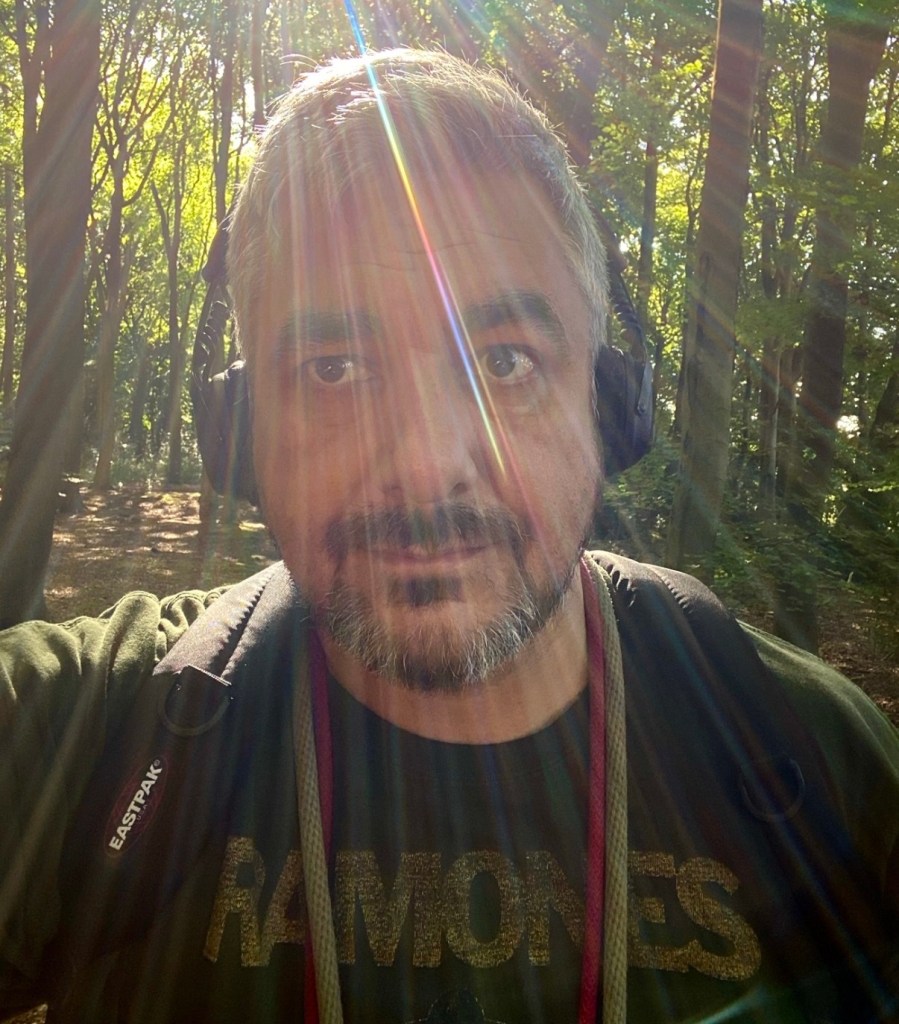
Sarah:
First things first — can you tell me a little bit about your writing? How long have you been doing it? What does writing do for you?
Steve:
My blog is nine years old. SteveForTheDeaf came from two things.
Firstly, as a long-haired, bone-idle twenty-something I spent hours debating music and trashy movies with other long-haired, bone-idle young folk in the pub. That was my kind of sport. I’m evangelical about low culture as high art.
Secondly, later on, I had a job that gave me untold hours alone in airports and hotels. Lots of travel, but on a fairly crappy budget. The blog felt like a fitting substitute for the pub. Me, my iPod, and my laptop wrote the first five years of it in waiting rooms, hotels, and terminals.
Over time, the writing itself started to wander. Reviews would drift into speculation, into narrative, into little flights of fancy. At the time it just felt like riffing, but looking back I think I was broadening my palette without really meaning to.
When Ted suggested setting up a story working group, it seemed to release something in me.
Like a sluice gate. And now I don’t seem to be able to stop writing short fiction.
It keeps me out of the pub at least.
Sarah:
The opening of your story evoked feelings of nostalgia in me for the farm where my grandparents lived. Your description of the cabin where your characters begin the tale is moving.
Does this setting resemble anything that you’ve experienced in your own life?
Steve:
I’m glad it invoked a feeling of nostalgia. I did not grow up on a farm. I was an inner-city kid. So this, for me, was a kind of latent wish-fulfillment thing.
I do live in the countryside now, and when I see kids in our village getting fields and forests on their doorstep — wow. I just love that for them. Go on, kid. Get out there. I’m a latent treehugger. I love being in the woods. I mean love it. I walk for miles when circumstances allow.
Through ancient forest and over hills. Me, my dogs, my wife. Heaven on Earth.
But I also know how I feel about where I grew up. I hated it then, and I hate it still. And when I knew I wanted to write from the perspective of a kid, I figured rural would help with an economy of characters.
Sarah:
Your protagonist could be anybody — any kid that never really fits into the life they’ve been handed. What do you think is the appeal of these kinds of misfit stories?
Steve:
I think we learn the rules of stories before we know we’re learning the rules of stories. Batman — or Master Wayne at least — Spider-Man, Carrie, The Ugly Duckling, Luke Skywalker. At their core they’re all “little kid lost”, off on an adventure.
At my most ambitious, I wanted to write something that had the sort of long shadows you find in A Monster Calls. Patrick Ness took an incomplete work from Siobhan Dowd and finished it after she died, and when I read it I was struck by the sense of before and after in that book.
And I love an eldritch horror concept. I’m a big old goth at heart.
I also think that in this day and age, it might only be the misfits who actually read.
Sarah:
I also want to ask you about the absent mother. This element is common in fairy tales. I’d say there are other parts of your story that evoke an “other” fantastical realm as well. Did fairy tales play a part in the writing of this story?
Steve:
I did want to write a fairy tale of sorts. I can’t escape Poe or the Grimm, but I also wanted an old- school science-fiction feel. Something that could be rendered as a practical special effect — on screen, or in the mind. I use that phrase a lot: on screen in the mind.
While my mum was present, my upbringing was very male-centric. My dad. My brother. Uncles. Grandfather.
All-male spaces are quite pungent.There’s rarely an objection to a workbench in the kitchen, a motorcycle engine on the dinner table, or Swarfega for hand soap on the lavatory.
Sarah:
Without giving too much away, would you say that the protagonist himself is like a tree that grows around wire?
Steve:
Without wanting this to sound like therapy-speak, I think we’re all trees that grow around wire in a way.
The problems we face in life, or the things that shape us along the way that weren’t necessarily part of the plan, are the things we absorb into our personalities, into our behaviours, into our psyches, even our decision-making processes.
In this particular instance, nothing grows around that wire, because anything that touches it is cleaved clean. But does the boy grow around the presence into a man? Yeah, I’d say he does.
And he gets pretty close to it changing the course of his life. Even though he may have gone unpunished, or excused by the timeless indifference of the thing, he would certainly have taken a different route.
Sarah:
Finally, the protagonist is challenged by some difficult family dynamics. I like the way you tell the story of him maturing into a different kind of person than his father. But there’s a moment in the tale where the reader thinks that this might not be the case — “there was before, and now we were in the after.” What do you think might have happened had that moment gone differently between the two cousins?
Steve:
When I was talking to Ted about this story while I was writing it and we were workshopping it, Ted described it as a villain origin story that didn’t. I liked that.
The father in this feels to me like many men, especially men of a certain generation, as something of a blunt instrument. When he’s hurt, his behaviour is inconsiderate and selfish, but hopefully not in a cartoon villain way.
I wanted what the boy encounters in the woods to sharpen him rather than harden him. To make him more attuned to fear, consequence, and restraint, rather than less.So the idea that he grows into a man capable of a good life — one grounded in mutual regard, in valuing another person’s perspective — felt important.
When his partner later suggests making something safe, she represents a form of care that isn’t
reactive or conditional. It’s simply present. She’s the first adult in the story who’s shown care as a resting state.
Sarah:
I loved reading these answers! Thanks for putting such time and care into them.
Steve:
Thank you Sarah. Can’t wait to hear about your story original.
 Poetry & More